

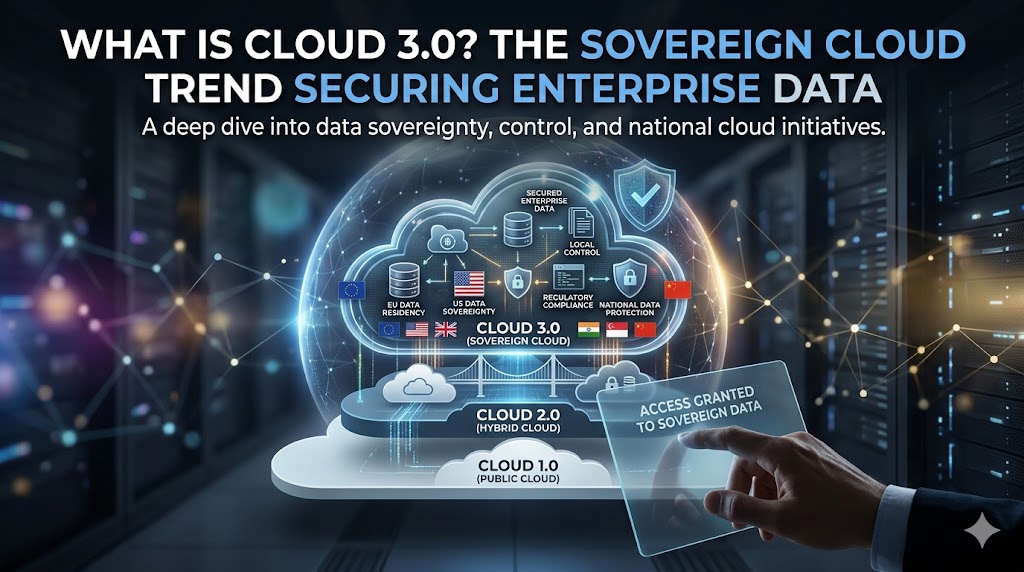
Move everything into the public cloud– this was the mantra of the tech industry for the past decade. It was cheap, unlimited, and widely advertised by the big tech companies. However, in 2026 things have turned upside down. Cloud 3.0 has arrived, and it is no longer only about scalability, it’s about sovereignty for enterprise IT.
So, why are businesses making an effort to shift the most critical data away from enormous public server farms and into the arms of a hyper secure architecture?
In This Article
The Evolution to Cloud 3.0
In order to appreciate the change, it is necessary to examine the evolution of cloud infrastructure in the last 15 years.
Cloud 1.0 Basic IaaS (Infrastructure as a Service)A server is being rented rather than purchased.Cloud 2.0Central SaaS & PaaSMassive global public clouds run by a few hyper-scalers.Cloud 3.0Sovereign & Hybrid CloudDecentralized, localized, and cryptographically isolated networks.
The AI Threat to Proprietary Data
Artificial Intelligence is the main driver of this change. In the past two years, gigantic public AI models have been hungrier than ever for training data. Suddenly, companies began to see that their proprietary algorithms, financial models, and customer databases when housed in vast, shared public clouds, were vulnerable to what was termed as “Shadow AI” — the possibility that the private IP could become part of a vendor’s core training model.
A Sovereign Cloud addresses this head-on. It is a cloud architecture that provides the agility of Cloud 2.0, but sets very clear and legally binding data boundaries. Ensures data residency – data is physically located in a particular country and adheres to only local privacy laws. Perhaps more significantly, it’s cryptographically isolated from the mega-AI scrapers.
Data Center Capacity Crunch
This shift is occurring at a time of critical global data center capacity shortage. The traditional hyperscale data-center is already filled, and the price of rack space has skyrocketed due to the massive processing power needed for AI.
Rather than bidding for costly place in a generic public cloud, forward-thinking enterprises are teaming up with special expertise sovereign suppliers. These local datacenters provide dedicated, single-tenant environments with custom silicon, ideal for secure, private AI workloads.
Inspect the following architectural breakdown to see how a Sovereign Cloud safeguards enterprise data and how it differs from the traditional model.
Key insight: With a Sovereign Cloud, the encryption keys remain with the client or a trusted third party in the same legal jurisdiction which means that the raw data cannot be accessed by the cloud provider.
If you aren’t certain where your data is stored, who’s responsible for the keys, and which models are using it, then you aren’t really in control of your data. Sovereign cloud is no longer an IT optional upgrade – it’s a business defence strategy.