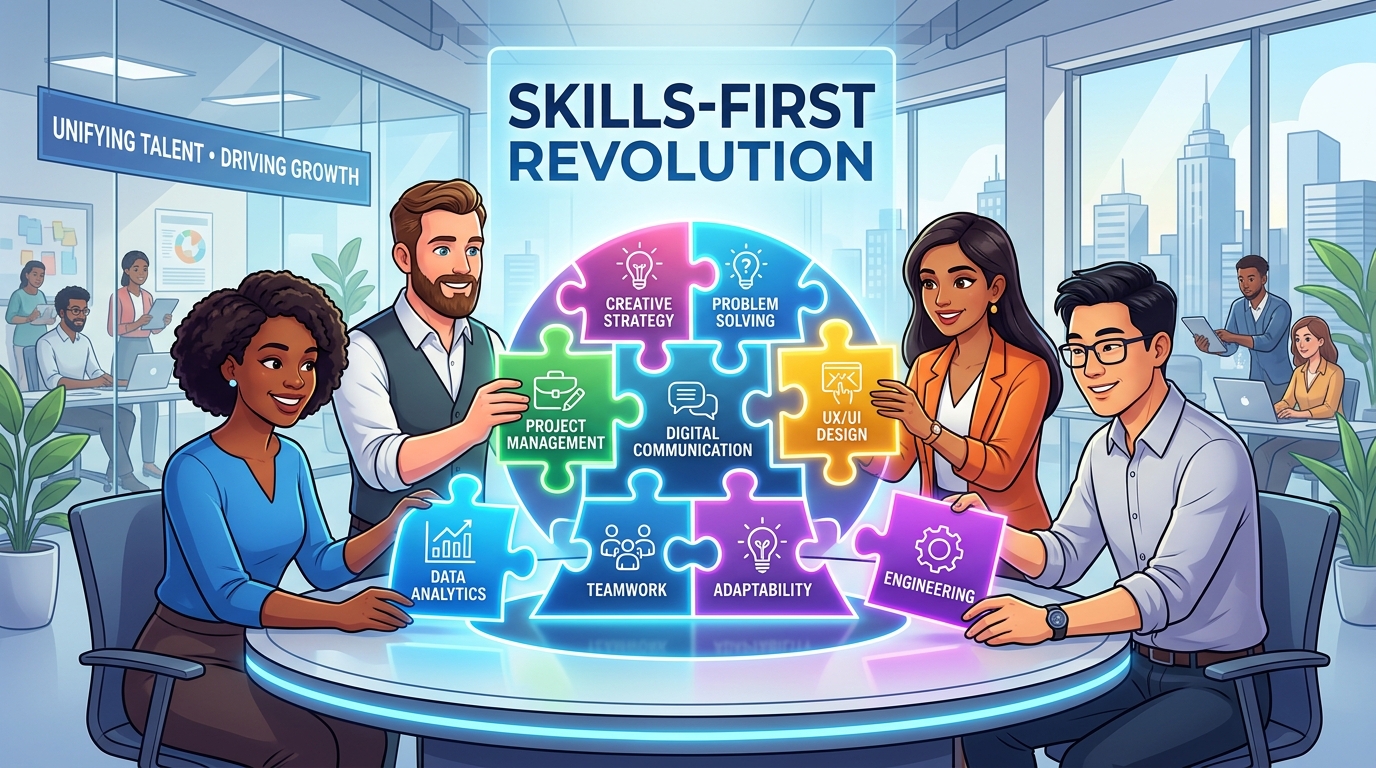
Is the old idea of the college degree being phased out by the Skills-First Revolution?
The stable, high-paying career track was known for generations, and stayed on the same path: High school graduation, four-year college, and then the corporate track. That diploma was a no-brainer for decades. Otherwise the resume would get lost in a pile of resumes and not be seen by a human being.
Yet a huge transformation is occurring with the current labor market. The times of hiring employees on the basis of their skills instead of their qualifications are here.
With a fast-changing economy and a huge lack of qualified professionals, large companies are actively eliminating the need for college degrees. Rather, they are interested in what a candidate can do “now”. This revolution completely reshapes the education scene, giving birth to new modular, flexible learning patterns, that are threatening the century-old university model.
The need for a degree has come into question.The value of the degree is being called into question.
Two primary economic factors are driving the change from the traditional degree: pace and cost.
Technology is advancing at a faster rate than education is being offered in the university setting; A computer science freshman may discover that by senior year, the languages and tools he or she acquired as a freshman are no longer in use.
With the price of higher education rising, many young professionals are wondering what they’ve gotten for their big loan. They want to go to work more quickly and directly, but without all the financial obligations of a long term loan.
In response, technology companies, banks and retail organisations are all waiving degrees for middle and even technical jobs. They’ve learned that rigid filters on degrees do not equate to competence, they only reduce talent.
The Rise of Modular Learning
The value of conventional education continues to take a hit, and a new educational world of alternatives is emerging. It’s based on “modular learning”—small, focused chunks of learning.
Instead of a four-year course of study in a wide range of disciplines, students are pursuing more focused technical training, coding programs and digital badges. These courses are tailored to address specific skills that are in demand, such as data analytics, digital project management or UX design. These can be executed in months, not years, and enable employees to quickly upskill or change careers on the fly.
Moreover, these micro-credentials are frequently created in close partnership with industry leaders, which means the skills learnt are relevant to the exact skills that are required by companies tomorrow.
But a skills-first approach doesn’t rule out the university degree. Structural engineering, medicine, law are all fields where formal institutional routes are still important. For many, however, a large part of the modern knowledge economy, the diploma is shifting from a requirement to one of many options.
This is the future of the U.S. national economy.This is the future of the U.S. national economy.
For the job-seeker, this change opens up opportunities to everyone. It provides a level playing field for career changers, community college graduates, and self-taught individuals who have demonstrated and real-world skills but who need to know they have the ability to earn a real-world credential without the cost of an expensive piece of paper.
For the education system it is a huge wake-up call. The mere name of the University is not enough to draw the students to the institutions. The traditional institutions need to adapt in order to be relevant in a skills-driven world, by providing more flexible, short-term certificates as well as their long-standing degree programs. The adaptable learner is the learner of the future and the market is clearly focusing on a proven ability rather than academic accolade.