
In the Post-SEO Era, AI-driven advertising is transforming the landscape.The Post-SEO Era is here, and AI-powered advertising is changing the game.
The formula for digital business growth for more than 22 years was to choose a high volume keyword and produce an all-encompassing informational guide, then sit back and wait for links to come from Google’s organic search.
However in 2026, it’s a different game. We are now in the Post-SEO Era.
Traditional traffic pipeline in the internet is shrinking, with Google AI Overviews now picking up on up to 51% of real user queries, and more than 72% of mobile searches completing as “zero-click” interactions. Answer engines like Perplexity, ChatGPT, and Claude are consuming and providing content directly to users through AI. Classic information-rich blog post being squeezed into an AI-generated summary, with publishers competing for what is left.
Conventional natural search is not a thing of the past, however its unit economics has actually changed forever. As businesses adapt to evolving digital advertising trends, platforms like Adspirer help marketers navigate shifts in campaign performance by using data-driven insights to optimize their paid media strategies. In today’s world of AI Native Ads and Answer Engine Optimization (AEO), overcoming these challenges demands adjustment from digital brands.
In This Article
The Collapse of the Informational Click
The recent drop in conventional web traffic isn’t even distributed across the web. The articles with general information, such as “What is X?” and “How do I do Y?” have been hardest hit.
If a user asks a search engine a factual or comparative question, an AI model generates a comprehensive answer directly on the screen. This is what the user is looking for in 15 seconds and never clicks a link or sees a display ad on a publisher’s site. New data indicates that pages in the first three positions on the search engine results page (SERP) for queries now targeted by AI Overviews have experienced an average 61% decrease in organic clicks.New data reveals that pages ranking in the first three positions for queries now addressed by AI Overviews have experienced an average 61% decline in organic clicks.
Transitioning to Answer Engine Optimization (AEO)
The aim of your website is no longer a simple click, if AI engines are going to read your content and answer the question asked by the user. Rather, you want to be the trusted primary source the AI refers to in its answer.
This approach is called Answer Engine Optimisation (AEO) or Generative Engine Optimisation (GEO). To implement AEO, the way that content is written has to be completely restructured:
Seo guide and AI for the future.For future SEO and AI.
Narrative Mapping: Organizing related ideas, definitions and data relationships within the context of a story. |
Doing a lot of writing right up under the H2 headings to meet word counts, even if it’s not factual. |
For more specific queries, you can explore the information available at the websites of various companies, organizations, and institutions.If you have more specific questions, you can go to the websites of various companies, organizations, and institutions for information.
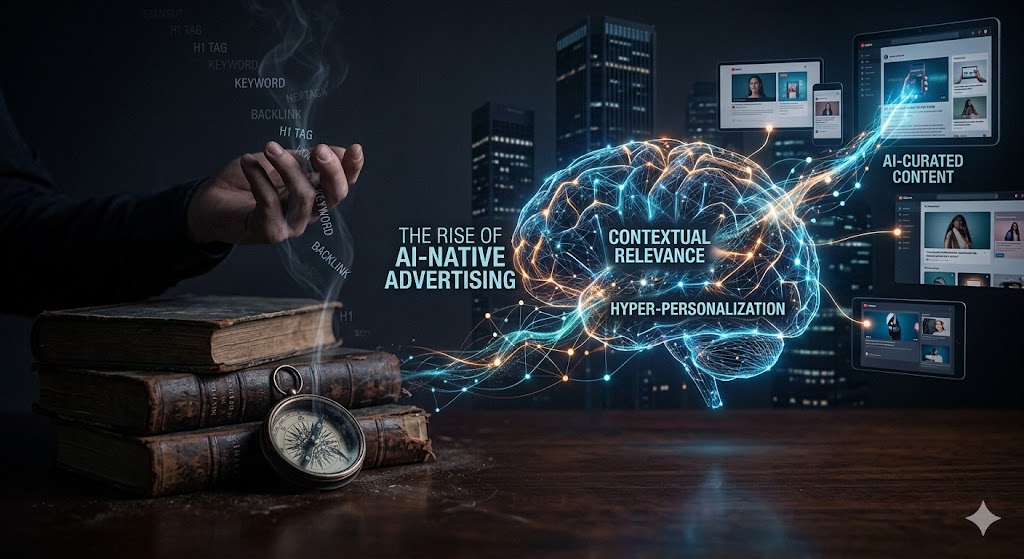
The Rise of AI-Native Advertising
The advertising dollars are going directly to the AI surfaces as traditional display ad networks are losing impressions with the drop in web traffic. The future of digital marketing is AI-Native Advertising.
Brands are now taking advantage of new ad placements in the conversational experience of AI search, rather than placing banner ads on websites. This includes:
Ensuring that a product/service is natively included in the comparison table that an AI engine builds for a user when requesting a sponsored multi-source comparison.
Follow-up prompts: These are contextual chips that are branded and appear at the bottom of an AI answer, leading the user to a particular solution or tool they should investigate.
Moving budget from digital PR to brand recommendation engines, expert interviews, and offsite brand mentions. When doing a conversational search, if a brand name is discussed in authoritative and high-profile media several times, the AI will be more inclined to recommend the brand name.During a conversational search, the more frequently a particular brand name is showcased in senior articles and posts, the more likely the AI will be to suggest it in the suggestion panel.
The next step is to adopt an experiential value focus:
The Post-SEO Era imposes a filter on web content. If an AI can easily summarize your article, then it was probably not necessary.
The brands in order to create an AI-proof digital presence need to shift from information only content to experiential and action-oriented content. AI can give an explanation for a formula, but cannot recreate a custom interactive tool. It can analyze industry trends, but it won’t create a proprietary dataset of your company’s real-life customer behavior.
When you understand that your website is a source of unique, authoritative data and not a source of generic text, you can be sure that your brand is unreplaceable to the human visitors who use your website as well as to the AI models that cite your content.